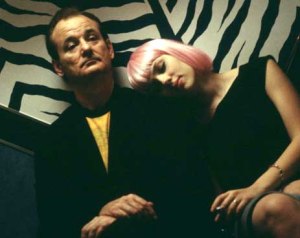
Can you keep a secret? I’m trying to organize a prison break. I need like, what, an accomplice. We have to first get out of this bar, then the hotel, then the city, and then the country. Are you in or you out?
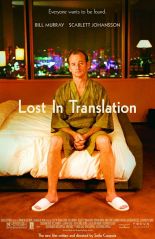
The movie opens with Bob Harris (Bill Murray) arriving from the United States at his hotel in Tokyo. Bob is a well-known action film star whose career is on the slide and he is in Tokyo to shoot a whiskey commercial. At a low point in his life and feeling a strong sense of culture shock, Bob is feeling lost and lonely, spending his non-working hours in his hotel. Here, he runs into another lonely person Charlotte (Scarlett Johansson), a philosophy graduate and young wife. Still trying to find her purpose in life, Charlotte is in Tokyo with her husband (Giovanni Ribisi), a successful photographer working in Japan. Left on their own a lot and both experiencing bouts of insomnia, Charlotte and Bob are drawn to each other, as they see a fellow displaced soul trying to find some meaning to life. During the course of the film, the two set off together and experience the craziness and frantic pace of the city. Through their growing relationship, they not only discover fun and adventure, but also their connection to life again.
Lost In Translation is a funny and poignant fish out of water tale of two lonely people who find themselves lost in a foreign city. There are moments that are extremely funny, as Bob and Charlotte find themselves at odds with the sensory overload of their foreign surroundings. There also moments that are extremely sad and touching, as these two very different people reach out to each other and share their feelings. Lost In Translation is Sophia Coppola’s second feature film as a writer/director and she has created a wonderful story of two people coming together against the bright and shining lights of Tokyo. Bill Murray, in particular, delivers a beautiful and understated performance that is both very funny and sad. The audience can see the depth of emotion and loneliness in his eyes. Lost In Translation is a touching and hopeful tale of two people who re-discover their humanity through connecting with another person. The film is a truly wonderful little film with a big message.
Lost in Translation was well received by critics and audiences. On Rotten Tomatoes, 95% of the critics gave the film a positive review, based on 219 reviews. On Metacritic, the film received a score of 89 out 100, based on 44 reviews.
The movie did well domestically at the box office, especially for a low budget, independent film, grossing over $44 million. It was the 67th highest grossing film of 2003. The top 10 films that year were: The Lord of the Rings: The Return of the King; Finding Nemo; Pirates of the Caribbean: The Curse of the Black Pearl; The Matrix Reloaded; Bruce Almighty; X2: X-Men United; Elf; Terminator 3: Rise of the Machines; The Matrix Revolutions; and Cheaper by the Dozen. Internationally, the movie took in over $119 million.
The film received many film awards, racking up 82 wins & 63 nominations. Lost in Translation was nominated for 4 Academy Awards, including Best Picture. The movie went on to win an Academy Award for Best Original Screenplay. The Best Picture winner that year was The Lord of the Rings: The Return of the King.
The things we touch have no permanence. My master would say: there is nothing we can hold onto in this world. Only by letting go can we truly possess what is real.
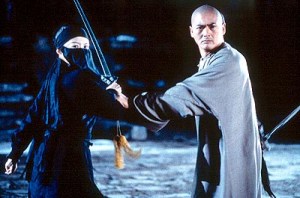
The first day of our festival took us to a mythical depiction of historic China and Ang Lee‘s masterpiece 2000’s Crouching Tiger, Hidden Dragon. The movie features an international cast headed by Yun-Fat Chow, Michelle Yeoh and Zhang Ziyi.
The film opens with legendary warrior Li Mu Bai (Chow Yun-Fat) meeting with his old friend and fellow skilled fighter Yu Shu Lien (Michelle Yeoh). Li Mu Bai has experienced an epiphany and has decided to give up his life as a warrior. He asks Yu Shu Lien to deliver his famed weapon, known as Green Destiny, as a gift to Sir Te in Peking, as she and her men are to safely transport goods there. Haunting both Li Mu Bai and Yu Shu Lien though is their unexpressed love for each other, as well as Li Mu Bai’s master’s death at the hands of the villainous witch Jade Fox. Upon her arrival in Peking, Yu Shu Lien meets Governor Yu’s daughter Jen (Zhang Ziyi), a strong-willed, adventurous girl who is not happy about her impending arranged marriage. Soon after, events take a sudden turn when Green Destiny is stolen by an unknown masked thief and Jade Fox re-enters the picture. Li Mu Bai is forced out of his short retirement and must join forces with Yu Shu Lien to regain the sword and battle his old enemy.
The film is a mystical and magical journey that plays out like a richly crafted fairy tale. The audience is swept away on an epic adventure, like being on a magic carpet ride. There are compelling and conflicted heroes/heroines, formidable villains, magic and true love. The cinematography and art direction are visually stunning and are accompanied by a beautiful and haunting score. The exciting fight sequences are inventive. The performances, especially from Michelle Yeoh, are compelling and richly nuanced. Crouching Tiger, Hidden Dragon is truly one of the great epic adventure films of the last decade, as it weaves a grand tale of redemption and love.
Crouching Tiger, Hidden Dragon was well received by critics and audiences. On Rotten Tomatoes, 97% of the critics gave the film a positive review, based on 143 reviews. On Metacritic, the film received a score of 93 out 100, based on 31 reviews.
The movie did well domestically at the box office, especially for a foreign language film in Mandarin Chinese, grossing over $128 million through a 31week run. It was the 12th highest grossing film of 2000, placing behind How the Grinch Stole Christmas; Cast Away; Mission: Impossible II; Gladiator; What Women Want; The Perfect Storm; Meet The Parents; X-Men; Scary Movie; What Lies Beneath; and Dinosaur. Internationally, the movie took in over $213 million.
The film also received many film awards, racking up 91 wins & 92 nominations. In 2000, Crouching Tiger, Hidden Dragon was nominated for 10 Academy Awards, including Best Picture. Crouching Tiger, Hidden Dragon went on to win 4 Academy Awards for Best Foreign Language Film, Best Cinematography, Best Art Direction and Best Original Score. The Best Picture Oscar winner for 2000 was Gladiator.
Today, the Hollywood Foreign Press announced their nominations for the 70th Annual Golden Globe Awards. Lincoln leads with seven nominations, including Best Picture, Director, Actor, Supporting Actor and Supporting Actress. Argo and Django Unchained each scored five nominations, while Zero Dark Thirty and Les Miserables, each earned four.
Here are the nominations:
MOTION PICTURES
Best Picture, Drama:
Argo
Django Unchained
Life of Pi
Lincoln
Zero Dark Thirty
Best Picture, Musical or Comedy:
The Best Exotic Marigold Hotel
Les Misérables
Moonrise Kingdom
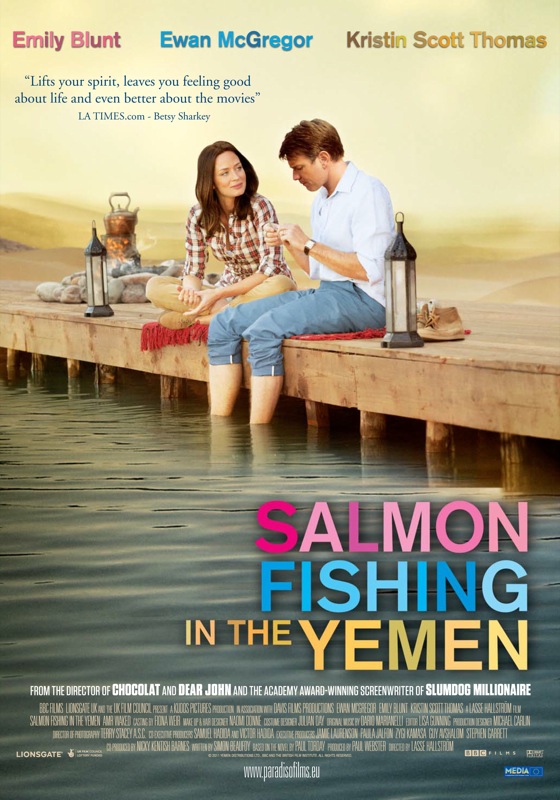
Salmon Fishing in the Yemen
Silver Linings Playbook
Best Director:
Ben Affleck, Argo
Kathryn Bigelow, Zero Dark Thirty
Ang Lee, Life of Pi
Steven Spielberg, Lincoln
Quentin Tarantino, Django Unchained
Best Actor, Drama:
Daniel Day-Lewis, Lincoln
Richard Gere, Arbitrage
John Hawkes, The Sessions
Joaquin Phoenix, The Master
Denzel Washington, Flight
Best Actress, Drama:
Jessica Chastain, Zero Dark Thirty
Marion Cotillard, Rust and Bone
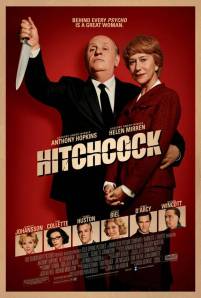
Helen Mirren, Hitchcock
Naomi Watts, The Impossible
Rachel Weisz, The Deep Blue Sea
Best Actor, Musical or Comedy:
Jack Black, Bernie
Bradley Cooper, Silver Linings Playbook
Hugh Jackman, Les Miserables
Ewan McGregor, Salmon Fishing in the Yemen
Bill Murray, Hyde Park on Hudson
Best Actress, Musical or Comedy:
Emily Blunt, Salmon Fishing in the Yemen
Judi Dench, The Best Exotic Marigold Hotel
Jennifer Lawrence, Silver Linings Playbook
Maggie Smith, Quartet
Meryl Streep, Hope Springs
Best Supporting Actor:
Alan Arkin, Argo
Leonardo DiCaprio, Django Unchained
Philip Seymour Hoffman, The Master
Tommy Lee Jones, Lincoln
Christoph Waltz, Django Unchained
Best Supporting Actress:
Amy Adams, The Master
Sally Field, Lincoln
Anne Hathaway, Les Miserables
Helen Hunt, The Sessions
Nicole Kidman, The Paperboy
Best Screenplay:
Mark Boal, Zero Dark Thirty
Tony Kushner, Lincoln
David O’Russell, Silver Linings Playbook
Quentin Tarantino, Django Unchained
Chris Terrio, Argo
Foreign Language Film:
Amour
A Royal Affair
The Intouchables
Kon-Tiki
Rust and Bone
Best Animated Feature Film:
Brave
Frankenweenie
Hotel Transylvania
Rise of the Guardians
Wreck-It Ralph
Best Original Song:
“For You” – Act of Valor
“Not Running Anymore” – Stand Up Guys
“Safe & Sound” – The Hunger Games
“Skyfall” – Skyfall
“Suddenly” – Les Miserables
Best Original Score:
Mychael Danna, Life of Pi
Alexandre Desplat, Argo
Dario Marianelli, Anna Karenina
Tom Tykwer, Johnny Klimek, Reinhold Heil, Cloud Atlas
Yesterday, the American Film Institute announced their selections for the top 10 movies and television shows of 2010.
The complete list of this year’s selections can be found below.
AFI Movies of the Year Argo
Beasts of the Southern Wild
The Dark Knight Rises
Django Unchained
Les Miserables
Life of Pi
Lincoln
Moonrise Kingdom
Silver Linings Playbook
Zero Dark Thirty
AFI TV Programs of the Year American Horror Story
Breaking Bad
Game Change
Game of Thrones
Girls
Homeland
Louie
Mad Men
Modern Family
The Walking Dead
Welcome to the 1st Annual Pop Culture Tales Holiday Movie Festival. First, I give you a brief history on how this festival came to be. There are so many great movies to see in a lifetime that I felt there needed to be a conscious effort for film lovers like me to see as many of these amazing films as possible. As a movie lover, this point really hit home for me after recently seeing some really bad movies. Using the book 501 Must-See Movies as my guide, here is the film festival schedule for the 2012 holiday season. Some of these movies I have seen already and some I have yet to see. Like a book club, I invite you to also watch as many of these films as possible from where ever you are. I will be sharing my reviews on this site. I invite you to share your thoughts as well.
“Are you making a pass at me, Mrs. Blaylock?” Loosely based on the novel by Whitley Strieber, The Hunger is a stylish erotic thriller directed by the late Tony Scott (Unstoppable), in his feature film debut, and featuring Catherine Deneuve (Repulsion), David Bowie (The Prestige), Susan Sarandon (The Witches of Eastwick) and a very young Willem Dafoe (Shadow of the Vampire) in one of his first screen appearances. A doctor (Sarandon), who specializes in research involving the aging process, encounters a murderous vampire couple (Deneuve and Bowie) and soon falls under the seductive spell of Deneuve’s character. The Hunger is a visually stunning and atmospheric piece that is both dark and glamorous in a style reminiscent of the music videos of the 1980’s. There is a slow and smoothly seductive tone to the movie, which features one of the most erotic seduction scenes ever seen on the big screen (between Deneuve and Sarandon). The film’s other strengths include the beautiful cinematography, the atmospheric score (including the enthralling opening sequence with Bauhaus performing Bela Lugosi’s Dead) and the strong performances (in particular Susan Sarandon as Deneuve’s tormented new lover). The film was not well received by the critics when it was first released. Since then The Hunger though has become a cult classic. The movie even spawned a short-lived television series with the same name. The Hunger was nominated for two Saturn Awards for Best Costumes and Best Make-up.
” You could learn a lot from children. They believe in things in the dark…” Based on a short story by M.R. James, Night of the Demon (AKA Curse of the Demon in the United States) is a British horror movie directed by French director Jacques Tourneur (Cat People) and featuring Dana Andrews (Laura) and Peggy Cummins (Gun Crazy). The film’s plot centers on an American psychologist (Andrews), who is a well-known debunker of paranormal phenomenon, and his investigation of a satanic cult and its charismatic leader, which may be responsible for sinister happenings including murder. There were numerous problems during the film’s production due to highly publicized fights between the producer Hal E. Chester and other members of the production company, including the director, screenwriter Charles Bennett and Dana Andrews. The producer even went over the head of the director (much to the dismay of the director, writer and star) and inserted images of the monster into the film, which the others felt took away from the scariness of the movie. Chester also had the movie edited down to 83 minutes to accelerate the pace of the movie and show it as a double bill in the United States. Despite these changes, The Night of the Demon still holds up as a horror classic—an understated supernatural tale where the director subtly uses shadows and atmosphere to chilling effect to build the suspense and terror. Modern critics are unanimous in their praise for the movie. Some fun trivia: Kate Bush’s song Hounds of Love includes dialogue from the film in the introduction: “It’s in the trees, it’s coming.” Night of the Demon is also one of the B-Horror movies cited in the song Science Fiction/Double Feature in the campy musical The Rocky Horror Picture Show: “Dana Andrews said prunes gave him the runes, and passing them used lots of skills.” Martin Scorsese included the movie on his list of the 11 scariest horror films of all-time.
In 2000, Ju-on was originally released as two low-budget straight-to-video Japanese television movies. Due to the surprise success of these videos, director Takashi Shimizu made a theatrical version Ju-on: The Grudge, released in 2002. The film’s story focuses on a haunted house with a horrific past, vengeful ghosts and a powerful curse. Anyone who enters the home and encounters the vengeful spirits is cursed and suffers horrible consequences. The movie’s plot is divided into six short interconnecting vignettes, which focus on characters that encounter the curse. The movie is an atmospheric and suspenseful series of ghost stories intricately woven together, which keeps the audience on their toes with each creepy ghostly encounter. The sequel entitled Ju-on 2 (Ju-on: The Grudge 2) was released in 2003. Equally scary is the American remake The Grudge released in 2004 and also directed by Takashi Shimizu. This version features Sarah Michelle Gellar (Buffy the Vampire Slayer) as a social worker who comes to the house to care for an elderly woman. The cast also includes Jason Behr, Clea DuVall and Bill Pullman. Though based on Ju-on: The Grudge, the American version features scenes re-enacted from the other Ju-on movies. The movie was not well received by most critics when it was released, but it did very well at the box office, grossing over 180 million worldwide and making it the second highest grossing horror remake of the past 40 years behind The Ring.The Grudge alsoreceived a number of award nominations, including a Saturn Award for Best Horror Film. Nominees that year included Dawn of the Dead and Saw with the award going to Shaun of the Dead. Don’t bother with The Grudge 2.
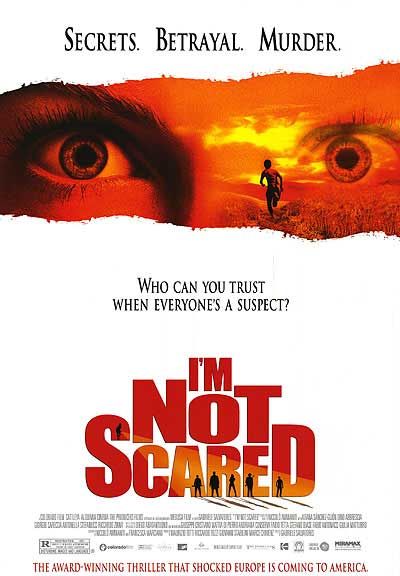
Based on a successful and acclaimed novel by Niccolo Ammaniti, this Italian thriller is directed by Gabriele Salvatores (Mediterraneo) and is loosely based on a true story of a kidnapped boy from Milan during the anni di piombo (a time noted for terrorism and kidnappings in the 1970’s in Italy). The movie takes place in 1978 during an exceptionally hot summer in a small Italian seaside village. While out playing, a nine-year old boy discovers another boy, lying shackled at the bottom of a hole, and uncovers an evil ransom scheme. The movie is a chilling tale about the loss of innocence. The director delivers a stunningly detailed period piece and effectively builds the suspense throughout the film right up until the exciting climax. The movie’s other strengths include the stunning cinematography and the strong performances by the large cast, especially Giuseppe Cristiano who plays the main character and had no previous acting experience. In fact, most of the actors in the movie were locals with no film experience. The movie was very well received when it debuted at the Berlin Film Festival. Within two days after the screening, thirty-two countries had purchased the rights to the film, including Miramax, which released the film to North American audiences and over a million at the box office. I’m Not Scared was also nominated or won many prestigious international film awards.
“Television is reality, and reality is less than television.” Set in Toronto in the early 1980’s, Videodrome is a Canadian horror movie written and directed by David Cronenberg (The Dead Zone) and featuring James Woods (Vampires), Sonja Smits (Street Legal) and Deborah Harry (Hairspray). A president of a cable televisions station (Woods), having grown dissatisfied with his station’s current programming, is looking for something new and revolutionary. He, however, gets more than he bargained for when he is introduced to a broadcast signal that features a show of unknown origin specializing in torture and murder. Soon, Woods’ character is drawn into a bizarre and twisted conspiracy where the line between reality and television blurs into mind control and strange organic hallucinations. The movie is a powerful and disturbing look at the early stages of reality television and its potential dangerous consequences if taken too far. When it was first released, the movie was not well received by audiences and received mixed reviews from the major critics. Videodrome has since received mostly positive reviews from modern critics for its visionary and techno-surreal depiction of a future dystopia. Videodrome was nominated for 8 Genie Awards (including Best Screenplay; Best Achievement in Art Direction, Cinematography and Film Editing; and Best Performances by Actors and an Actress in a Supporting Roles). Cronenberg won the Genie for Best Achievement in Direction in a tie with Bob Clark for A Christmas Story. Videodrome is ranked fourth on Bravo’s 30 Even Scarier Movie Moments. The Toronto International Film Festival ranked it 89th in the most essential movies in film history.














 Terry Gale's Pop Culture Tales